
| Small Business
Research preview
2026 LinkedIn x Ipsos small business findings
Early insights from LinkedIn and Ipsos on what’s shaping small business growth in 2026.

This preview shares early findings from LinkedIn’s 2026 small business study with Ipsos on how small businesses are building credibility, using relationships to create opportunities, and adopting AI.
Across the research, one theme comes through clearly: as small business leaders manage limited time, lean teams, and changing expectations, lasting growth depends on strong foundations, including credible brand signals, trusted relationships, practical AI workflows, and clearer growth planning.
This is an early release of select findings. A full research experience with expanded insights will be available later this year.
Brand presence and credibility
Why does brand credibility matter for small business growth?
For many small businesses, lead generation is often driven by founder-led outreach, customer relationships, and referrals. Visible proof such as case studies and customer logos can help make the business’ value easier to understand, reinforce that existing trust, and give buyers more confidence before they reach out.
Small business takeaway
Make customer proof easy to find. Testimonials, case studies, customer logos, and a clear online presence can help small businesses build confidence before a buyer is ready to act.
Key findings
53%
of decision-makers say customer testimonials and case studies most effectively build trust for their organization.
55%
of sales decision-makers say customer testimonials and logos are among the most credible content types.
58%
of marketing decision-makers say they use LinkedIn to build their brand presence.
The power of networks
How do relationships help small businesses create pipeline?
Small business growth is still deeply relationship-driven. The findings show that relationships can influence both the volume and speed of pipeline: referrals can help businesses reach prospects with more built-in trust, while warm introductions can reduce the friction that often comes with cold outreach.
Small business takeaway
For small businesses, networks can be a real source of pipeline. Referrals, founder-led outreach, and warm introductions can help create more relevant conversations with people who already have a reason to trust the business.
Key findings
41%
of small businesses say referrals drive the most lead volume.
61%
of businesses say customer or partner referrals produced closed-won deals last year.
36%
Deals progress 36% faster when initiated through warm introductions instead of cold outreach.
53%
of small businesses say the founder or owner primarily owns lead generation.
AI for scale and speed
How are small businesses using AI to work more efficiently?
AI is moving from experimentation into everyday use. The findings suggest that small businesses are looking for practical AI use cases that can show clear value through time saved, productivity gains, and easier workflows. With CEOs and owners often responsible for AI strategy, trust and measurable impact are important alongside efficiency.
Small business takeaway
Focus on AI use cases that fit the way the team already works. When AI helps reduce manual effort, support revenue-generating work, or make everyday tasks easier to manage, it becomes easier to evaluate, justify, and adopt.
Key findings
95%
of small businesses are using AI today to some degree.
58%
of companies cite increased efficiency and productivity as a benefit of using AI.
49%
of companies measure AI’s impact by hours saved or automation rate.
52%
of small businesses say the CEO or owner is responsible for AI strategy and governance.
Growth priorities and capacity planning
What do these findings say about how small businesses are planning for growth?
The research suggests that small businesses are not measuring growth through a single lens. They are balancing revenue and acquisition goals with retention, cash flow, and capacity. The findings point to a practical tension: small businesses are focused on generating demand, but they also need the capacity, skills, and planning to support it.
Small business takeaway
Use planning to connect growth goals with capacity decisions. As demand increases, clearer planning can help small businesses decide when to hire, when to automate, and where to focus.
Key findings
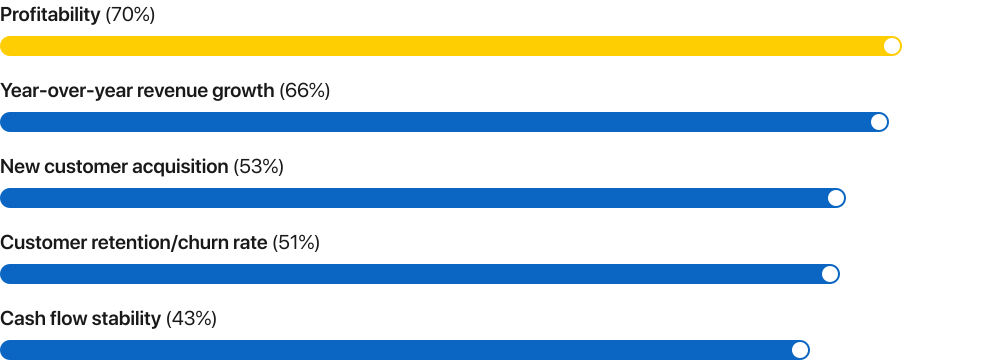
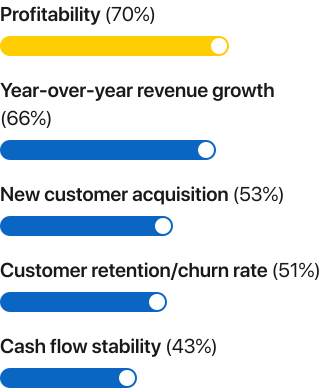
Small business decision-makers most often measure company success by profitability (70%), year-over-year revenue growth (66%), new customer acquisition (53%), customer retention/churn rate (51%), and cash flow stability (43%).
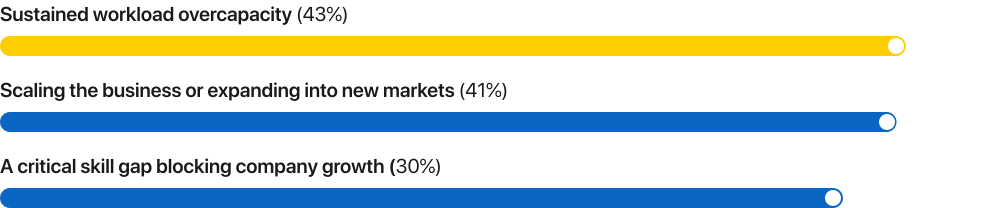
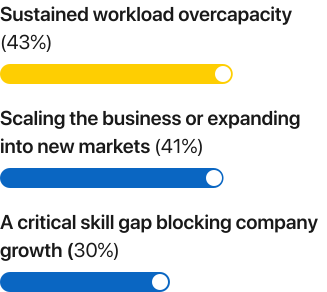
Small businesses are most often prompted to hire because of sustained workload overcapacity (43%), scaling the business or expanding into new markets (41%), and a critical skill gap blocking company growth (30%).
What these findings mean for small businesses
Visible proof can help small businesses build trust earlier.
Testimonials, case studies, customer logos, and a clear online presence can help buyers understand the business’ value, see what sets it apart, and feel more confident before reaching out.
Networks are a competitive advantage.
Referrals, warm introductions, and founder-led relationships can help create stronger pipeline with more built-in trust.
AI works best when it supports real workflows.
Small businesses are using AI to save time, improve productivity, and reduce manual work. The strongest use cases are tied to real workflows, not experimentation for its own sake.
Growth needs better planning, not just more activity.
Profitability, revenue growth, acquisition, retention, cash flow, workload, and skill gaps all help small businesses understand what healthy growth looks like and what support they need next.
Frequently asked questions
Small businesses most often measure success by profitability (70%), year-over-year revenue growth (66%), new customer acquisition (53%), customer retention/churn rate (51%), and cash flow stability (43%).
Social media (69%) and email (65%) are the primary marketing channels companies use most often. On LinkedIn specifically, 62% of marketing decision-makers cite reaching B2B audiences as a use case.
Referrals are both a lead source and a revenue driver: 41% say referrals drive the most lead volume, and 61% say referrals produced closed-won deals last year. On average, deals also progress 36% faster when they begin through warm introductions.
49% of companies measure AI’s impact by hours saved or automation rate, and 58% cite increased efficiency and productivity as a benefit of using AI.
The most common triggers are sustained workload overcapacity (43%), scaling into new markets (41%), and a critical skill gap that is blocking growth (30%).
About this research
LinkedIn partnered with Ipsos to survey 300 U.S. small business decision-makers at companies with 2–50 employees in early 2026. Respondents had decision-making responsibility in at least one area, including budget and strategy, marketing and advertising, sales, or hiring and learning. The sample included participants from both an expert network and a B2B panel.
Related resources

Discover why — and where — early-career professionals are building their own businesses.
Discover practical ways to use AI to boost productivity, marketing, sales, and hiring.
Ready to grow your business?
Explore LinkedIn tools that drive growth, measure impact, and keep your small business moving forward.

