

The third annual LinkedIn State of Sales report studies this new landscape, including the expectations of today’s B2B decision makers and the modern selling strategies and technologies employed by B2B sales professionals to scale their impact, outperform their peers and close more deals.
Read on for the Key Findings from this year’s LinkedIn State of Sales report—and how you can use these insights to boost your sales performance.




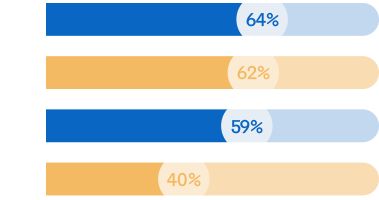
More than half of sales professionals (64%) use CRM tools like Salesforce and Microsoft Dynamics—up 28% from 2017
62% use collaboration tools like Box, Google Docs, Microsoft Office and Dropbox—up 6% from 2017
59% use networking platforms like LinkedIn and Facebook—up 5% since 2017
40% use enterprise communication platforms—up 8% since 2017

Personal connection matters. As beloved B2C brands have conditioned everyone to expect highly personalized recommendations, content and personalized interactions, decision makers have embraced similar expectations of the B2B path to purchase. Conventional sales approaches don’t stack up—buyers now find them cold, impersonal and obviously automated.
As a result, decision makers are more likely to consider a brand’s products or services when the experience is personalized, for instance if a sales professional has a clear understanding of their business needs (96%) or their role (94%); shares content relevant to their role (93%); provides personalized communications (93%); or targets the appropriate people at their company for initial discussions (92%).
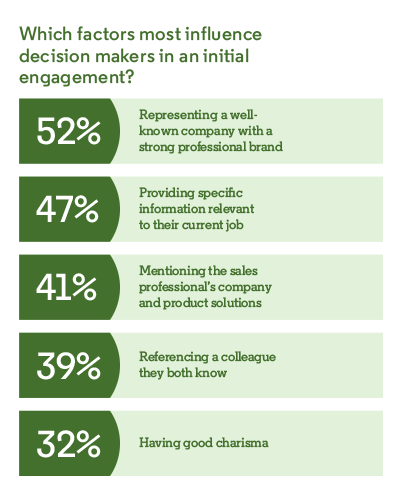
Decision makers are more likely to engage with sales when introduced through a mutual connection, particularly if the sales professional represents a strong brand. The influence of a strong brand increased by 37% since last year and is the No. 1 factor cited by decision makers when choosing to engage with sales.
Decision makers are least likely to engage with sales professionals who lack knowledge about their company (79%)and whose products or services are irrelevant to their company (76%).



It’s more important than ever for sales professionals to earn and maintain trust as consumer skepticism of big brands peaks.
Ninety-nine percent of sales professionals say trust is “very important” or “important” to winning new business. Forty percent rank trust as the most important contributor to closing a deal—even above ROI of the product or service (28%) and price (18%). An additional 24% rank trust second. Trust has led as a priority factor influencing deals since our first survey in 2016.
Fifty-one percent of decision makers rank trust as the No. 1 factor they desire in a salesperson, followed by responsiveness (42%), expertise in the field (42%), problem solving (37%) and transparency (34%).
Sales professionals earn high marks from buyers.
When asked how they perceive sales professionals they work with, decision makers “strongly agree” or “agree” sales professionals are:


Want to learn more about Sales Navigator?
See how LinkedIn Sales Navigator can help drive sales success

Request a Demo
A sales specialist will contact you shortly