


Leaders must clearly define and hire the right people for key roles and responsibilities when planning and launching a new sales organization. They must also learn how to build a sales team structure from the ground up.
This guide outlines a winning sales team structure and explains crucial roles and hierarchies. We also share strategies and tools required to hire, train, and support sales teams to win new clients and grow sales revenue quickly.
What is a sales team structure?
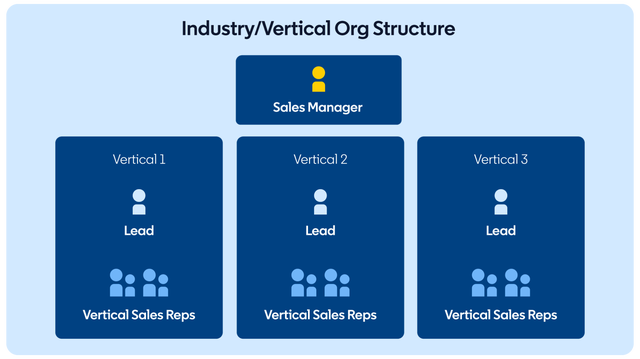
A sales team hierarchy, or structure, illustrates crucial roles within a sales organization and how they support internal staff while growing key customer accounts. Sales teams can be structured to support customers in geographic regions, by sector or industry specialization, product or service specialization, and company revenue size. Ultimately, the sales organization’s size influences the creation of team roles, responsibilities, and account support needs.
Why hiring the right roles and salespeople matters
Recruiting experienced leaders and professionals with the right industry or product expertise is essential for building a sales team. They are the first point of contact with new customers, boosting product and service awareness and reaching new markets. Ideal sales support and account management professionals also help increase efficiencies in onboarding new client accounts and growing sales revenue with their existing customer base. In turn, these support roles allow sales organizations to stay nimble and reduce customer churn and marketing acquisition costs.
Prioritize diversity, equity, and inclusion at this stage
During the hiring process, sales leaders should prioritize diversity, equity, and inclusion (DEI) within their team(s). This strategy helps businesses connect and engage with a broader customer base and brings new perspectives and solutions to business challenges.
A recent Forrester Consulting study commissioned by LinkedIn found that supporting DEI within sales organizations leads to the following:

A lift in sales forecasts:
Leading DEI sales organizations increased team revenue forecasts by 9% versus a 6% increase for lagging organizations.

Better conversion rates:
Sales teams using DEI best practices achieved an average lead-to-opportunity conversion rate of 54%; just 26% for lagging DEI sales organizations.

Higher sales attainment:
Sales teams with exceptional DEI practices reached 43% sales attainment; lagging DEI organizations reached 31%.

A boost in customer satisfaction:
Sales teams with prioritizing DEI increased customer satisfaction scores by 24%; lagging sales organizations lifted scores by 17%.
Should businesses hire inside or outside sales teams?
There may be some confusion about whether to build an inside sales team and/or an outside sales team first. Let’s review the difference.
Inside sales are often called “remote” or “virtual sales” strategies and processes. This sales team operates out of a company office, call center, or an individual’s home. It also may involve third-party vendors who work to qualify sales leads before passing them on to outside representatives within an organization.
Inside sales processes do not require face-to-face meetings with prospects, and involve frequent conversations and collaboration with marketing teams to help nurture leads through the sales process.
Outside sales involves the traditional sales model where reps travel to client offices – across different regions and time zones – to meet in person. These sales reps bring materials such as collateral, laptops or tablets, and company swag to build customer relationships face-to-face and demonstrate the value and benefits of using their products and services. Salespeople will take as many trips and meetings as necessary to close a sale and grow the account – investing money on travel and other expenses, like meals and tickets to sporting events, to increase sales revenue long-term.
Larger, more advanced sales teams often use both sales methods, with inside reps being the initial point of customer contact for inbound leads that arrive through B2B marketing efforts. Outside salespeople focus on generating new, outbound sales leads through cold calling, tradeshow attendance, or email outreach efforts.
Smaller organizations often first build up their outside sales team. They may even hire an external vendor to act as a remote inside sales team, collaborating with internal teams through online collaboration tools, which we’ll describe shortly. As sales organizations grow, they will slowly hire inside sales representatives to work in-house with B2B marketing teams and senior outside sales representatives.

Sales team structure, roles, and responsibilities
Below is an overview of typical outside sales roles and responsibilities and how they are structured within a mid-to-large-sized organization. Smaller sales organizations often combine these roles under alternate titles to compensate for fewer staff members. Startups might hire an outsourced sales team that looks and functions like the one described below before hiring internally.
Director or Vice President (VP) of Sales
It is the most senior-level position within a sales organization. They hire and manage all senior sales professionals on the team. They also develop organizational sales plans, revenue targets, and compensation plans, often with the help of a Sales Enablement or Operations Team Lead and/or an Account Team Leader. Directors or VPs are valued for their experience managing large sales teams and have extensive industry knowledge and team leadership skills.
The Sales Director or VP reports to the CEO or President within their organization and is compensated based on the performance of the entire sales team.
Account Team Leader or Director (By Region or Industry)
Industry or regional Account Team Leaders or Directors also play an essential role in sales team management, developing account team sales plans, hiring, and coaching employees from Sr. Account Executives to Junior Sales Reps or Coordinators. They are valued for their prior sales team management skills and have often worked as account executives in past roles.
They report to a Director or VP of Sales and ensure their teams get the training and tools they need to succeed. They are compensated based on the sales revenue performance of their regional account or industry team.
Account Executive
Account Executives are the main point of customer contact. They handle prospective customer outreach, lead nurturing, closing deals, and growing sales revenue with new and existing customers. They are often hired for industry-specific or regional client knowledge and typically have five to seven years of experience working with target customers and accounts.
They work with account management and sales support team members to ensure customers are happy with their products or services. Account Execs report to the Account Team Lead, who can escalate client issues higher up the chain of command. Account Executives are compensated for meeting quarterly and annual sales targets.
Account Manager or Sales Support Specialist
Support Specialists or Account Management sales professionals help new and existing customers get the best product or service experience possible. They typically have three to five years of experience working in a sales support or account management role and have an intimate knowledge of their customers’ most significant challenges, providing timely and effective solutions.
Account Managers and Sales Support Specialists work closely with Account Executives, attending sales calls and meetings when needed – often acting as internal product or service consultants. They also onboard new clients and maintain regular contact with them. They are compensated for helping their team meet quarterly and annual sales targets, reporting to the Account Team Leader.
Account Coordinator or Junior Sales Associate
Finally, Account Coordinators and Junior Sales Associates support the entire Account Team in developing proposals, handling contracts between clients and internal Finance teams, and supporting Account Managers on day-to-day administrative and client tasks.
They, too, report to the Account Team Leader and have one to three years of client and sales support experience. They are also compensated for helping teams meet sales targets.
Steps for building a winning sales team
Below are important steps to help Directors, VPs, and account team leaders when recruiting, training, and managing a sales team.

Step 1: Recruit top sales talent
Identify all roles and responsibilities required to find the right professionals for the sales team. Often the first people hired are senior-level sales Directors or VPs.
They will then create the sales team structure and recruit account leadership and executive roles. In turn, Account Team Leaders will hire at least one account support and junior specialist in the early stages of a sales team.
Ultimately, sales leaders seek new team members who are collaborative, personable, open to continuous learning, and easy to coach and manage. These skills are crucial for fostering positive team dynamics and a healthy and sustainable company culture that supports other team members, including junior staff.
Businesses frequently work with HR professionals and/or external headhunters to help them find and hire sales talent – especially when seeking professionals with industry or product-specific knowledge.
During employee onboarding, sales leaders will provide teams with documentation and product or service training to help them succeed. They must also set expectations for individual KPIs, payment and incentives for meeting or exceeding sales targets, employee codes of conduct, and skills development. This information is crucial for having open and honest dialogue, during their quarterly or annual performance reviews, about whether employees are meeting expectations and where they can improve.
Step 2: Train and coach sales teams
Regularly train new and existing employees on the company’s latest products or services, new updates or features, partner programs, sales tools, and customer support processes or workflows. Team leaders and sales operations can also train external vendors with the same materials, provided contractors sign a non-disclosure agreement (NDA), ensuring that all information remains confidential.
Other training resources to provide include new sales strategies, battle cards, and discovery call best practices. New teams will naturally have fewer training resources than larger, more established sales organizations.
Schedule weekly, monthly, or quarterly sales training sessions, and record mandatory training sessions for busy sales professionals to access on-demand. Software companies often create certification programs, as well, ensuring sales teams maintain advanced product or service knowledge.
These resources and training opportunities are essential for employee learning and development. Each team member should have a plan to regularly develop and improve their sales skills and product or service knowledge. Many sales leaders include mandatory training attendance in their employees’ quarterly or annual KPIs, ensuring high-quality customer service and support.
Step 3: Invest in the right sales tools
Sales leaders should consider the tools and platforms suggested below when building a tech stack to support sales team success and automate sales processes.
1. A CRM tool like Salesforce or Microsoft Dynamics for logging sales calls, tracking team revenue targets, and creating performance reports.
2. An integrated sales tool like LinkedIn Sales Navigator to sync with their CRM.
3. Team collaboration tools for sharing industry and product knowledge, sales presentations, and staying in contact (e.g., Microsoft Teams) from around the globe.
4. A scheduling tool that allows prospects and customers to book online meetings and sales demos.
5. Video and presentation tools to conduct live online product demos and virtual client calls.
These tools are essential for allowing inside and outside sales teams to easily connect and collaborate from different office locations or remotely at any time. They also help improve internal communications to maximize customer support and satisfaction.
Step 4: Track and measure sales team success
Sales VPs, Directors, and Account Team Leaders must hold themselves and their teams accountable by establishing key metrics to measure success. These metrics should align with company goals and objectives, helping leaders properly compensate sales staff and monitor key performance indicators (KPIs) for employee performance reviews. Critical factors to take into account include:
Average monthly, quarterly, and annual revenue: Metrics measured by account teams or reps, depending on how teams are organized. To calculate it, divide the total team revenue by the total number of sales reps during a specified time period.
Average win rates: Evaluate the percentage of closed and won deals versus the sales pipeline's total opportunities during a specific period.
Average deal size: The average size (in dollar amounts) of current deals managed by account teams or reps over a certain time period.
Average sales cycle length: The average time it takes account reps and teams to close and manage deals (end-to-end) over a set period.
Weighted pipeline value: The total value of potential deals in an account team’s sales pipeline in any given period, which sales leaders can use to forecast future revenue targets.
Sales leaders can calculate these metrics via Excel reports and/or create a dashboard in their CRM tool to regularly monitor sales KPIs. They often incentivize account reps and teams to log this information in CRM tools to keep sales data and metrics current, or include these inputs as part of the team’s KPIs.
Incentives can include gift cards, additional pay in their quarterly or annual bonuses, and technology gifts or company swag. These incentives are also commonly used to encourage sales reps to exceed their revenue targets.
Building and managing a sales team with LinkedIn
Hiring the right staff to win new sales opportunities and retain valuable customers is crucial. Be sure to prioritize inclusion, equity, and diversity when recruiting to improve customer satisfaction and achieve better sales outcomes.
While sales team structures may vary, depending on the organization’s size, hiring for the key roles and responsibilities highlighted in this guide is essential. LinkedIn provides sales organizations with recruitment access to over 850 million professionals worldwide.
Sales leaders must regularly train and coach employees to succeed. To thrive in an ever-shifting competitive landscape, they must also provide staff with the right sales tools in their tech stack including CRMs and virtual meeting software.
LinkedIn Sales Navigator provides sales teams with real-time, high-quality relationship intelligence data for researching prospective clients, growing their pipelines, and making deep connections with the right prospects when they are ready to buy their product or service.
Get started with LinkedIn Sales Navigator
Want to learn more about
Sales Navigator? Let us help:
Want to learn more about
Sales Navigator? Let us help:


